43 years of US mining incidents, 1983 to 2025
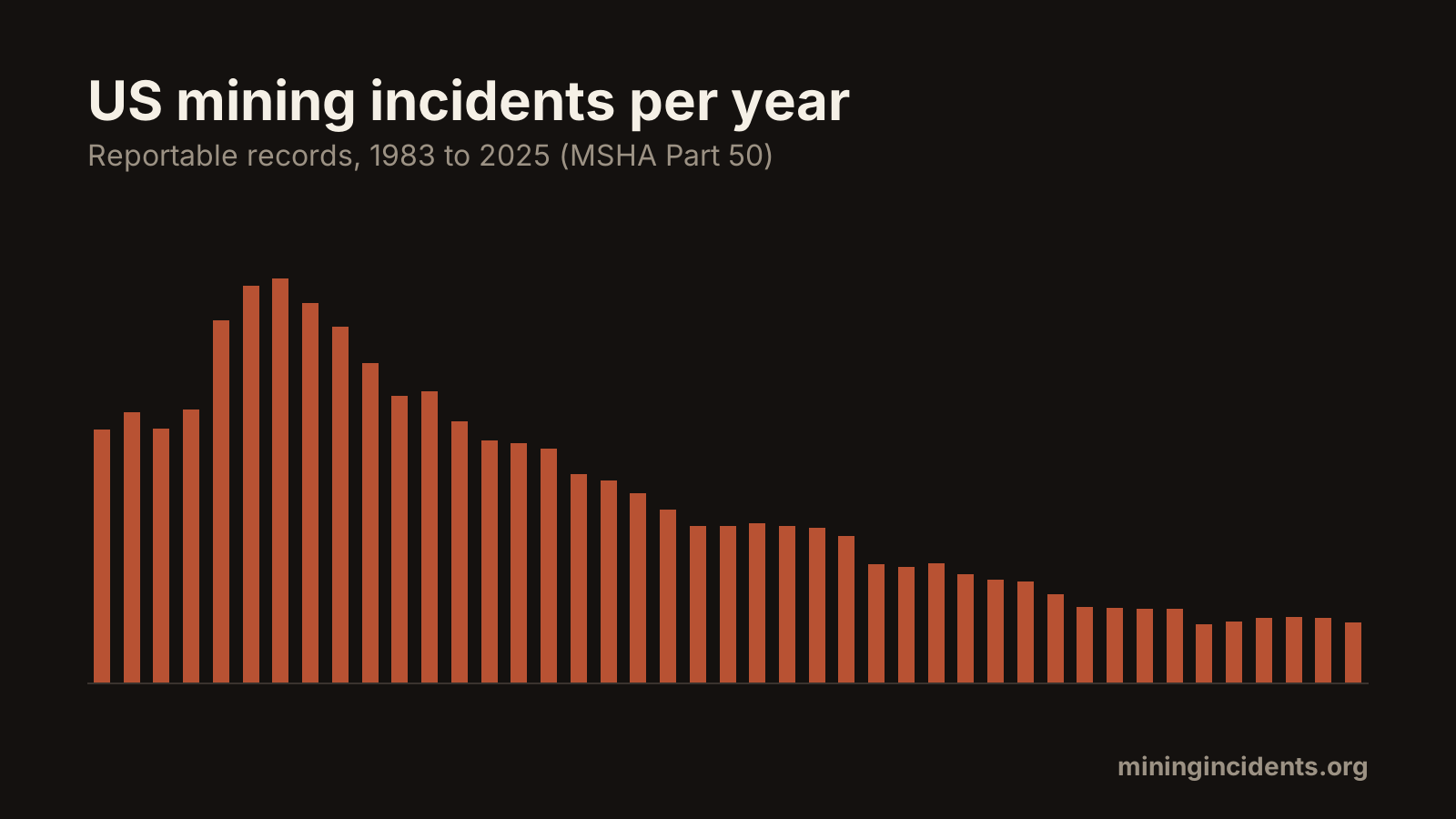
Mining Incidents now indexes every reportable accident, injury, and illness on file with the US Mine Safety and Health Administration back to 1983, the start of MSHA's electronic Part 50 record. That is 739,073 records across 43 years, 3,109 of them fatal. Coverage previously began in 2000; the 1983 to 1999 records were added from MSHA's per-year Part 50 archives and cross-checked against NIOSH's published fatality counts.
The long-run trend is a steady decline. Reportable incidents peaked at 37,363 in 1989 and have fallen to about 5,600 a year since 2020, down roughly 85 percent from that peak. The pattern tracks a contracting mining workforce alongside four decades of changing practice and enforcement. The record holds the counts, not the causes.
Fatalities followed the same path. 1983 recorded 132 mining deaths; 2024 recorded 28 and 2025 recorded 33, a decline of about three quarters. The deadliest single year on the electronic record is 1984, with 206 deaths. That total includes the 27 miners killed in the Wilberg Mine fire in Emery County, Utah, in December of that year.
Coal and metal/nonmetal mining are close to even on the record. Coal accounts for 385,461 of the incidents and 1,543 of the fatalities; metal and nonmetal account for 353,612 incidents and 1,566 fatalities. By the counts on file, metal and nonmetal mining has been marginally the deadlier sector across the full period.
Every record is searchable by mine, operator, controller, year, severity, occupation, and any keyword in the MSHA investigator's narrative, including the pre-2000 records added in this update. miningincidents.org/search