How coal-mine respirable silica measures against MSHA's new 50-microgram limit
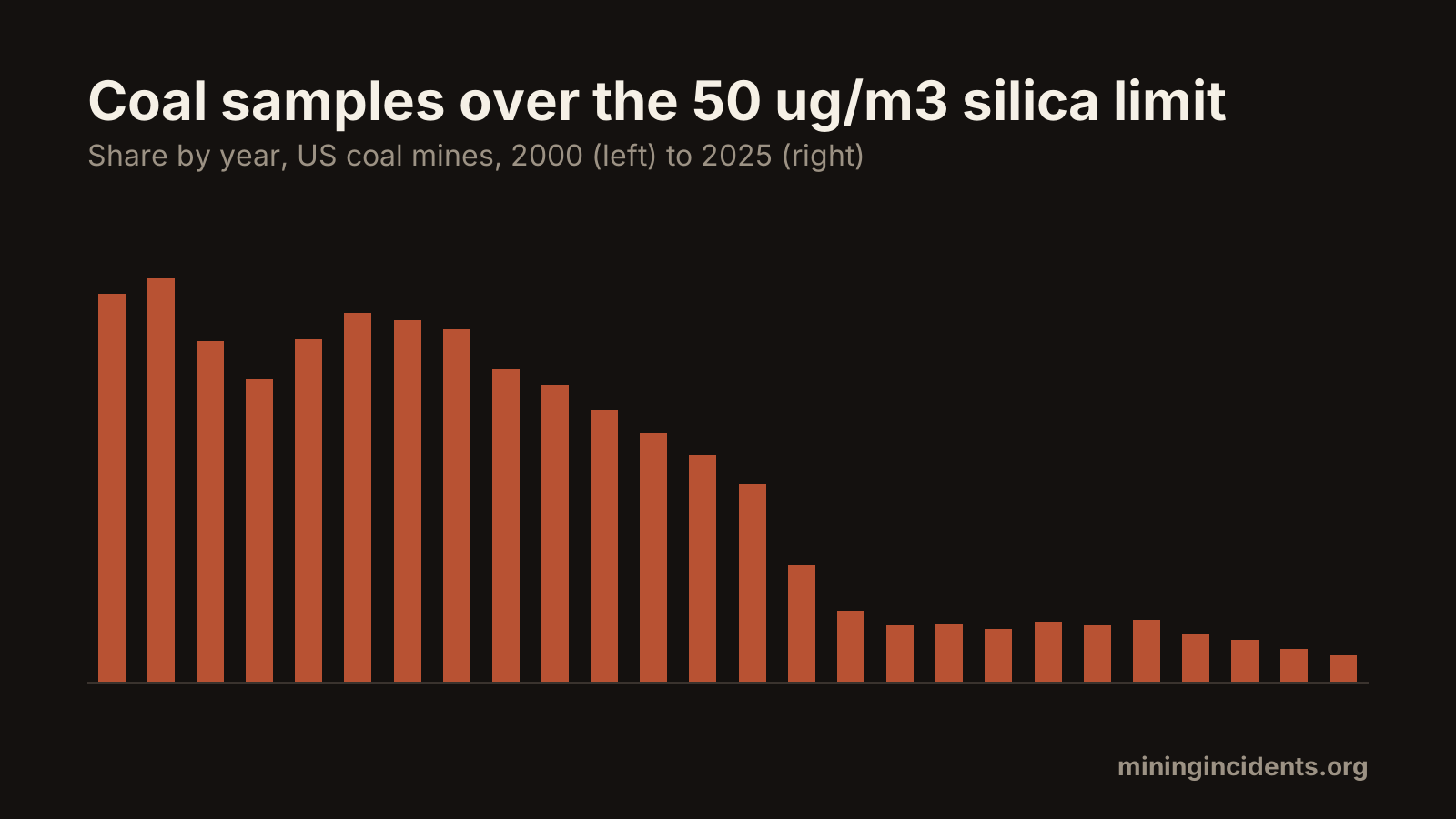
MSHA's 2024 respirable crystalline silica rule sets one limit for coal mines: 50 micrograms of silica per cubic metre of air (µg/m³). It is the number that now governs compliance, and it is a number MSHA does not publish. The agency reports respirable coal-dust concentration in one sampling file and the crystalline-silica percentage of that dust in another, and leaves the two unjoined. We joined them, sample by sample (silica equals dust concentration multiplied by quartz fraction), for 146,268 valid coal-mine samples from 2000 through 2026, and measured each against the 50 µg/m³ limit. This is the industry-wide picture that results.
The trajectory is steep. In 2000 and 2001, more than half of coal-dust samples carried enough silica to exceed the new limit (50.8% and 52.8%). By 2013 that share was down to 26%, and the sharpest drops coincide with the phase-in of MSHA's 2014 respirable-dust rule: 15.4% in 2014, then 9.5% in 2015. It has kept falling since, to 4.5% in 2024 and 3.6% in 2025. The 95th-percentile sample fell from roughly 200 µg/m³ in 2000 to about 43 µg/m³ in 2025. Respirable silica in U.S. coal mines today is a small fraction of what it was a generation ago.
The decline is real, but it is not zero. Across the modern-standard era, 2015 to the present (76,095 samples at 1,353 mines), 6.7% of samples still exceed the 50 µg/m³ limit: about one in fifteen. The 95th-percentile sample sits at 57.4 µg/m³, just over the line. The new rule is not a formality that the industry already clears with room to spare. A meaningful tail of sampling still lands above it, and that tail is where compliance and liability attention will concentrate.
Exceedance is not spread evenly. Since 2015, the highest rates among well-sampled states are in Colorado and Alabama (about 10.5% each), then West Virginia (7.8%) and Utah (7.7%). The two largest coal-sampling states, West Virginia and Kentucky, sit at 7.8% and 6.3%. The lowest rates are in the surface-heavy western basins and the Illinois basin. The pattern tracks what an industrial hygienist would expect: underground Appalachian coal, cut from quartz-bearing rock, carries more respirable silica than surface lignite and sub-bituminous mining.
A note on method and limits. These are derived estimates, not a figure MSHA reports. Each value is respirable dust concentration multiplied by the crystalline-silica fraction of the same physical sampling cassette, converted to micrograms per cubic metre. We use only valid, non-voided samples, exclude physically impossible dust readings above 50 mg/m³, and keep one derived value per cassette. The 50 µg/m³ limit is MSHA's 2024 standard; samples from earlier years were taken under a different regime, so exceeding the limit here means a sample would exceed the standard now in force, not a historical citation. And sampling is not a census of every shift at every mine. The aggregate trend is robust across more than 146,000 samples; any single mine's figure should be read alongside its sample count.
This is the industry aggregate. Where a specific operator or mine stands against the 50 µg/m³ limit, and which mines carry the exposure, is the per-entity view behind these numbers. Mining Incidents produces that as a silica readiness profile, scored per sample against the limit and benchmarked to the national baseline above. For a specific operator, email [email protected]; a sample of how we present an operator's MSHA record is at miningincidents.org/sample-report. The underlying dust and quartz data are public record; the derived concentration and the benchmark are what we add.